

In this issue:
-
Event Recap: Columbia Students for Size Inclusivity Journal Club
-
NEW MSSI Resource: Pediatric Weight-Management Informed Consent Project
-
Evidence-Based Archives: GLP-1 Agonists and Eating Disorders
-
Featured Article: Being an anti-diet doctor isn’t radical by Dr. Mara Gordon
Event Recap: Columbia Students for Size Inclusivity Journal Club
Disclaimer: We use the terms “ob*sity” and “overw*ight” in our summaries when it is otherwise impossible to accurately describe findings from certain studies, due to the language and descriptors chosen by researchers. We acknowledge the inaccuracies and harms that these labels have perpetuated in medicine and society. Please keep your mental health in mind when reading, and feel free to reach out to us with any feedback or suggestions at any time!
Columbia Students for Size Inclusivity (CSSI) had their 3rd event of the semester on November 3rd! Vice President, Griffin Gowdy led a journal club discussion where the group critiqued the weight-centric paper from the Global BMI Mortality Collaboration, “Body-mass index and all-cause mortality: individual-participant-data meta-analysis of 239 prospective studies in four continents.”
The group used the article, “Flawed methods and inappropriate conclusions for the health policy on overweight and obesity: the Global BMI Mortality Collaboration meta-analysis” to build on their arguments critiquing the weight-centric paper. (Learn more through MSSI’s “Evidence-Based Archives” summary of this paper).
Arguments critiquing the Global BMI Mortality Collaboration meta-analysis include that they used highly selective, non-systematic data, excluded large portions of available data and deaths, relied on flawed analytic restrictions that were inadequately justified, and failed to properly address significant sources of bias like self-reported weights; as a result, its conclusions about overweight and obesity increasing mortality globally are unreliable and should not guide health policy or clinical decisions.
After participants critiqued the article, they were surprised at the major impact and broad recognition within the scientific and medical community that this paper holds. Despite the meaningful flaws in data inclusion and analysis that this paper was published in the Lancet, one of the highest-impact medical journals in the world and cited over 3300 times, indicating its use in subsequent research, reviews, and policy discussions.
During the journal club, we enjoyed some delicious food from a local restaurant, Native Noodles!
 |
 |

NEW MSSI Resource: Pediatric Weight-Management Informed Consent Project
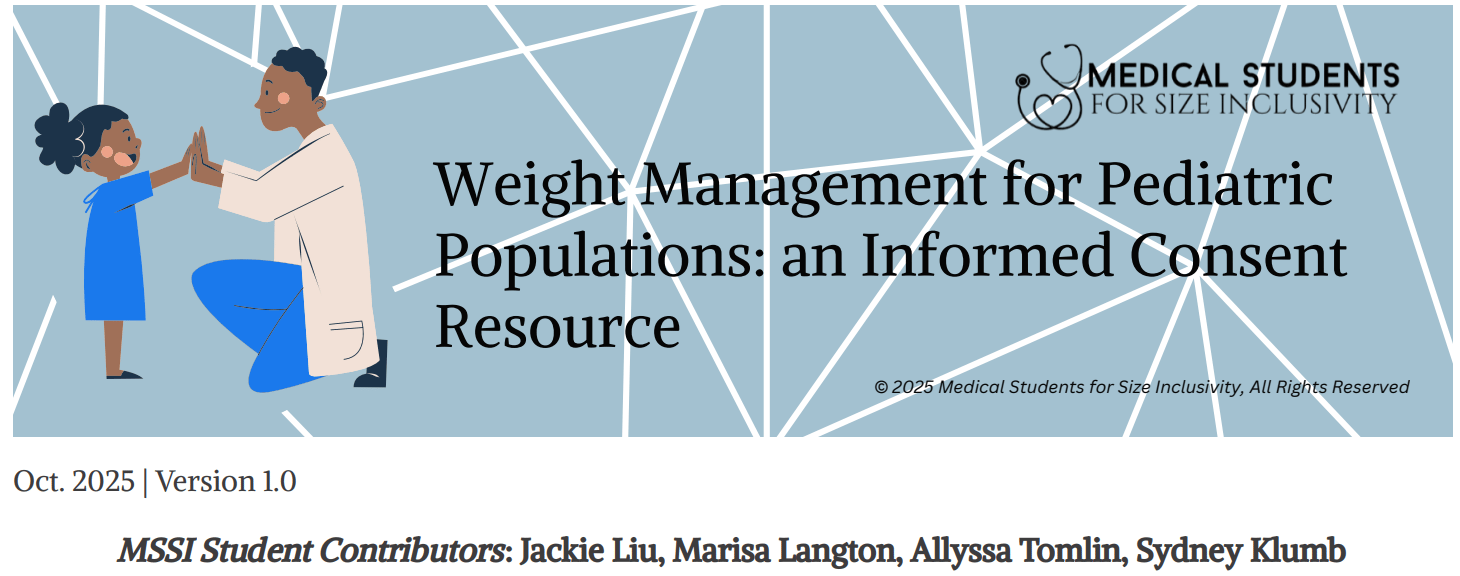
MSSI is excited to announce a NEW informed consent resource on Weight Management for Pediatric Populations, authored by MSSI Advocacy Co-leads Jackie Liu and Marisa Langton, Curriculum Committee member Allyssa Tomlin, and MSSI member Sydney Klumb!
This is a parent-facing resource describing and explaining the risks and benefits of different weight loss interventions that pediatricians may recommend, as well as weight-neutral approaches to supporting overall childhood health and wellbeing. In light of current AAP guidelines around management of childhood “o**sity” (read more about issues with the guidelines here), this document may help parents navigate potentially unsolicited advice on weight management for their child. While MSSI does not agree that weight and health are directly linked, we respect individual choices and the process of shared decision-making and hope that this resource will help guide trauma-informed and compassionate conversations.
Browse our other informed consent projects on GLP-1s and bariatric surgery.
MSSI is working on a version of this resource for kids! If you are interested in contributing to our work, please reach out to sizeinclusivemedicine@gmail.com.

Evidence-Based Archives
MSSI is excited to present another installment of “Evidence-Based Archives,” our monthly column highlighting and summarizing seminal research in the field of size-inclusive healthcare. In this section, we hope to celebrate our scholars, empower each other with knowledge, and stock up on citations for the next time we’re called upon to justify size-inclusive healthcare in the classroom, clinic or wards!
Content warning: Eating disorders, ob*sity, anti-fat language
Disclaimer: We use the terms “ob*sity” and “overw*ight” in our summaries when it is otherwise impossible to accurately describe findings from certain studies, due to the language and descriptors chosen by researchers. We acknowledge the inaccuracies and harms that these labels have perpetuated in medicine and society. Please keep your mental health in mind when reading, and feel free to reach out to us with any feedback or suggestions at any time!
This month’s highlight: Bartel, S., McElroy, S. L., Levangie, D., & Keshen, A. (2024). Use of glucagon-like peptide-1 receptor agonists in eating disorder populations. The International journal of eating disorders, 57(2), 286–293. https://doi.org/10.1002/eat.24109

As GLP-1 receptor agonists (GLP-1RAs) like semaglutide, liraglutide, and tirzepatide continue to make headlines as “miracle” and “game-changing” weight-loss drugs, clinicians are increasingly encountering a challenging question: What do these medications mean for people with a history of eating disorders?
This month, we highlight a 2024 narrative review by Bartel et al. that synthesizes what is currently known and what remains unknown about GLP-1RAs in eating disorder (ED) populations.
Objectives of the review:
The authors synthesize the limited evidence available on GLP-1RAs and EDs. They discuss the potential risks and benefits, evidence on these medications in the management of binge eating, and directions for future research. They also provide readers with a practical guide for discussing GLP1-RAs with patients.
1. Potential harms: Could GLP-1RAs worsen ED symptoms?
The authors acknowledge that GLP-1RAs may worsen or trigger ED pathology by suppressing appetite, altering hunger and fullness cues, and promoting rapid weight loss. They also discuss that common side effects of these medications (i.e. GI upset, nausea) often result in reduced interest in eating, further enabling dietary restriction.
Much of this discussion is appropriately cautious, but also vague, reflecting the extremely limited evidence base. As The Cut recently reported, even non-ED-affected users describe concerning appetite blunting and emotional detachment from eating, underscoring the potential for serious risk in those with a pre-existing history of disordered eating.
2. Potential ?benefits: Can GLP-1RAs treat binge eating?
The review summarizes existing literature exploring GLP-1RAs as a treatment for binge eating:
-
Animal models: Two animal studies (Cao 2014, and Pierce-Messick & Pratt 2020) suggest GLP-1RAs may reduce binge eating behaviours.
-
RCTs: The authors found only one randomized controlled trial (Allison 2023) that randomized twenty-seven participants with BED to liraglutide or placebo for 17 weeks. Liraglutide showed non-significant reductions in binge episodes but did result in greater weight loss. Study limitations were substantial, including randomization errors and low baseline binge frequency.
-
Non-blinded trials:
-
One study (Robert 2015) randomized 44 adults with high Binge Eating Scale (BES) scores to liraglutide or diet/exercise groups for 12 weeks. They found liraglutide reduced BES scores and body weight.
-
Another study (Da Porto 2020) randomized 60 adults with diabetes and BED to dulaglutide or gliclazide for 12 weeks. Those with dulaglutide therapy had greater reductions in BES scores and body weight.
-
-
Retrospective cohort: One study (Richards 2023) suggested semaglutide may reduce binge eating symptoms more than other combinations of “weight loss” medications including topiramate, lisdexamfetamine dimesylate, or others.
Across studies, improvements in binge eating were often tied to weight loss, raising the question of whether reductions reflected true BED remission or rather, shifts toward restrictive eating…
Studies to date share major limitations:
-
Very small sample sizes
-
Few RCTs
-
Short study durations
-
Outcome tools that poorly assess ED psychopathology
-
No studies in anorexia nervosa, bulimia nervosa, ARFID (or any ED other than BED)
The authors of the review emphasize the need for rigorous trials that include validated measures of dietary restraint (not just weight-centric metrics that may falsely suggest remission), and longer term follow ups to capture possible rebound binge eating once medication effects diminish.
3. Are we adequately accounting for harm?
While Bartel et al. outline potential risks, their discussion of harms remains conservative. They conclude that there is insufficient evidence to support the use of GLP-1 mediations to treat ED symptoms at this time, and that, “…more research is required before negative or positive conclusions can be drawn about the impact of GLP-1As on EDs psychopathology”. In clinical practice, several of us MSSI students and clinicians have anecdotally seen a different picture.
Because EDs are deeply stigmatized and frequently undiagnosed in people living in larger bodies, many of our patients may not disclose or volunteer symptoms such as bingeing, purging, laxative misuse, or compulsive exercise. These patients are frequently prescribed GLP-1RAs without appropriate ED screening or counselling.
For individuals with a history of disordered eating, the appetite suppression and rapid weight loss induced by GLP-1RAs can:
-
exacerbate existing ED symptoms
-
trigger the onset of a new ED
-
reinforce pathological restriction
-
enable compensatory behaviours
-
mask ED relapse behind “successful” weight loss
Clinicians are increasingly reporting cases where GLP-1 initiation precipitated severe deterioration or ED relapse after years of stability (Trollope-Kumar 2025). These events are serious and under-recognized.
Given the life-threatening medical and psychiatric risks associated with EDs, any medication that can precipitate or intensify restrictive behaviour warrants far greater caution than the current literature reflects.
So, should GLP-1RAs be contraindicated in people with a history of EDs?
Current guidelines and drug monographs do not list eating disorders as a contraindication to GLP-1 RA use.
However, based on growing evidence, clinical experience, and the well-documented risks of ED relapse and restriction, we suggest that at the very least:
-
All patients should be screened for past or current ED symptoms before GLP-1RA initiation.
-
Patients with ED histories should receive informed consent that includes discussion of potential ED risks (see MSSI’s informed consent resource here).
-
Prescribers should be aware that EDs are common in higher-weight populations and are often hidden.
-
Close monitoring should be routine and should include psychological assessment.
-
ED specialists should be involved whenever possible.
Above all, care should prioritize patients’ relationships with food, movement, and their bodies, not weight-centric metrics.
References:
1. Bartel, S., McElroy, S. L., Levangie, D., & Keshen, A. (2024). Use of glucagon-like peptide-1 receptor agonists in eating disorder populations. The International journal of eating disorders, 57(2), 286–293. https://doi.org/10.1002/eat.24109
2. Davis, A. P. (2025, November 13). Life in beige. The Cut. https://www.thecut.com/article/glp-1-weight-loss-drugs-ozempic-sex-drive-side-effects.html
3. Cao, X., Xu, P., Oyola, M. G., Xia, Y., Yan, X., Saito, K., Zou, F., Wang, C., Yang, Y., Hinton, A., Jr, Yan, C., Ding, H., Zhu, L., Yu, L., Yang, B., Feng, Y., Clegg, D. J., Khan, S., DiMarchi, R., Mani, S. K., … Xu, Y. (2014). Estrogens stimulate serotonin neurons to inhibit binge-like eating in mice. The Journal of clinical investigation, 124(10), 4351–4362. https://doi.org/10.1172/JCI74726
4. Pierce-Messick, Z., & Pratt, W. E. (2020). Glucagon-like peptide-1 receptors modulate the binge-like feeding induced by µ-opioid receptor stimulation of the nucleus accumbens in the rat. Neuroreport, 31(18), 1283–1288. https://doi.org/10.1097/WNR.0000000000001545
5. Allison, K. C., Chao, A. M., Bruzas, M. B., McCuen-Wurst, C., Jones, E., McAllister, C., Gruber, K., Berkowitz, R. I., Wadden, T. A., & Tronieri, J. S. (2022). A pilot randomized controlled trial of liraglutide 3.0 mg for binge eating disorder. Obesity science & practice, 9(2), 127–136. https://doi.org/10.1002/osp4.619
6. Robert, S. A., Rohana, A. G., Shah, S. A., Chinna, K., Wan Mohamud, W. N., & Kamaruddin, N. A. (2015). Improvement in binge eating in non-diabetic obese individuals after 3 months of treatment with liraglutide – A pilot study. Obesity research & clinical practice, 9(3), 301–304. https://doi.org/10.1016/j.orcp.2015.03.005
7. Da Porto, A., Casarsa, V., Colussi, G., Catena, C., Cavarape, A., & Sechi, L. (2020). Dulaglutide reduces binge episodes in type 2 diabetic patients with binge eating disorder: A pilot study. Diabetes & metabolic syndrome, 14(4), 289–292. https://doi.org/10.1016/j.dsx.2020.03.009
8. Richards, J., Bang, N., Ratliff, E. L., Paszkowiak, M. A., Khorgami, Z., Khalsa, S. S., & Simmons, W. K. (2023). Successful treatment of binge eating disorder with the GLP-1 agonist semaglutide: A retrospective cohort study. Obesity pillars, 7, 100080. https://doi.org/10.1016/j.obpill.2023.100080
9. Trollope-Kumar, K. (2025, August 27). RE: Eating Disorders and GLP-1 Agonists [Online forum]. CMAJ. https://www.cmaj.ca/content/re-eating-disorders-and-glp-1-agonists
10. Medical Students for Size Inclusivity. (2023, Nov.). GLP-1 Agonist Medications: Informed Consent Resource. https://sizeinclusivemedicine.org/glp1/
Thoughts?
We are open to feedback and interested in the lived experiences of our MSSI members. Have you referenced this article in your clinical work, used it to guide patient counseling, or used it to communicate with your colleagues? How did it go?
Feel free to share your stories, reflections, expertise, and advice using the links below. With your permission, we may publish reflections in future installments of this column.
If you have a favorite article you’d like us to highlight in our next installment, feel free to submit it for consideration, also by using the link below! We look forward to hearing from you!
Featured Read: Being an anti-diet doctor isn’t radical by Dr. Mara Gordon
One of our members came across this great article by Dr. Mara Gordon on why anti-diet care really isn’t a radical idea. It’s a quick, thoughtful read & we highly recommend.
Instagram post
This newsletter was authored by MSSI members Sophie Lalonde-Bester (University of Alberta) and Jay Liu (Stanford University).